Analogue Sheep : Vol 11 : The Orchard of Unmade Princes
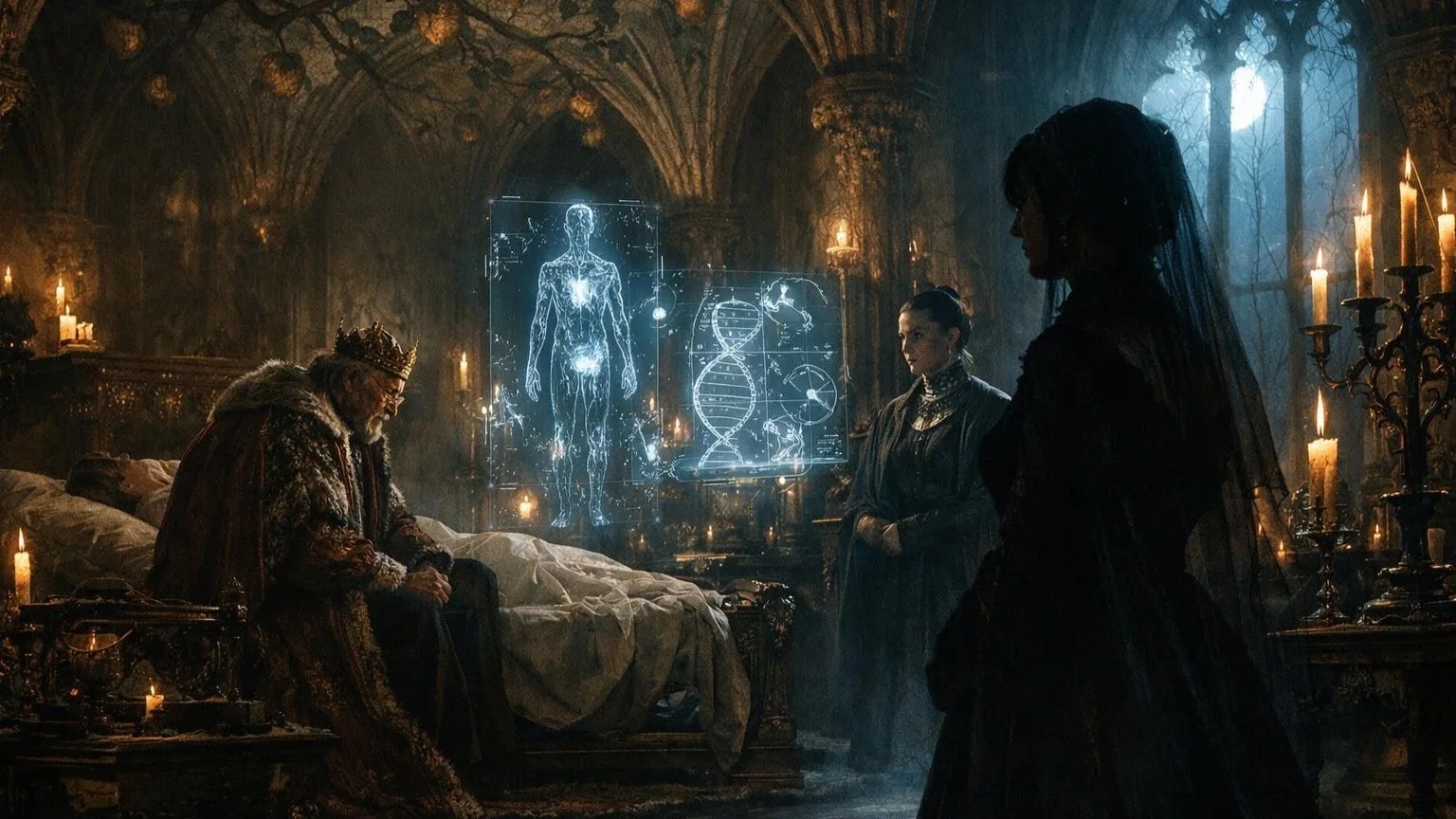
They called it the Orchard because the ceiling above the Palace Infirmary was painted with branches that never shed their leaves.
The branches were old - older than the King - and the paint had been retouched so many times that the fruit looked thick, like it might drop from the plaster with a soft thud and roll across the tiles. If you stared long enough, you could convince yourself the fruit was ripening. If you stared long enough, you could convince yourself of anything.
Prince Halden lay in the centre of the Orchard, not in a bed but in a cradle of cloth webbing designed to imitate weightlessness. The webbing was pale and clean, as if cleanliness might persuade the body into compliance. It held him the way a spider holds a fly: carefully, reverently, and without mercy.
His eyes were open. They were always open now.
“Tell me what you see,” the King said.
The King did not ask the physicians. He asked the Queen.
Queen Seren stood at the rail of Halden’s cradle, her fingers wrapped around it so tightly the knuckles had blanched. The breath-monitor projected its quiet ribbon of numbers into the air above him, an aurora of maths. The ribbon trembled, steadied, trembled again - like a hand trying to write a word it had forgotten.
“I see my son,” she said.
The King’s mouth tightened in a way the court painters always softened.
“No,” he said. “Tell me what you see that I cannot fix with laws.”
He was not cruel, not in the way history liked to use the word. Cruelty suggested impulse. The King was methodical, a man who loved lists and levers. The old dynasties had ruled by myth. This one ruled by process.
Across the room, the attending physicians did what they always did when the King spoke: they held still, like statues that might be forgiven for being alive. Their uniforms were bone-white. Their collars carried the silver thread of the Crown’s oath.
The newest physician - Doctor Vell - stood slightly apart. Not from fear. From calculation.
The King’s gaze found Vell the way a magnet finds iron.
“Doctor,” the King said. “You were the one who used the word radical.”
Vell inclined her head. “I said there is a procedure.”
Seren felt the word procedure move through the room like a draught. It slid under doors. It found skin.
“What is it called?” the King asked.
Vell hesitated just long enough to appear human. “In the old manuals, it was a euphemism. It was called the Lantern.”
The King made a small sound. Not approval. Not disgust. Interest.
“And what does the Lantern do?” he said.
Vell stepped forward and, with a gesture, drew a new projection beside Halden’s ribbon of numbers. It blossomed into an anatomical lattice - halos and filaments, the body rendered as light, the organs as gentle shapes.
“In lay terms,” she said, “it allows us to map inheritance patterns faster than waiting for them to express. It gives us access to the cascade. It lets us test without… time.”
Seren watched the lattice flicker. A child’s body reduced to a diagram. A future reduced to an if.
“Without time,” the King repeated softly, as if tasting it.
“Yes,” Vell said. “We can see the mark. We can see where the error copies itself. We can see the mechanism. From that, we can attempt a correction, or at least an intervention.”
“And what is the cost?” Seren asked.
The physicians did not look at her. The King did.
Vell’s voice remained steady. “We need a closer sample.”
Seren’s stomach tightened. The Palace had become a museum of samples: Halden’s blood in crystalline vials, Halden’s skin in thin sheets, Halden’s saliva frozen into beads. There had been months of rituals dressed as care.
“What kind of sample?” Seren asked, though she heard in her own voice that she already knew.
Vell’s projection shifted. A smaller lattice appeared, the suggestion of a body not yet shaped into recognisable grief.
“A sibling,” Vell said. “Early enough that the mechanism is clear. Late enough that the mechanism is complete.”
Seren heard a breath she didn’t realise she’d been holding leave her chest. It left like a confession.
The King’s face did not change. His eyes flicked to Halden, then back to Vell, like a man comparing two tools.
“You mean,” the King said, “another child.”
Vell nodded. “Conceived naturally is best. The Crown’s Line carries the pattern. We need the line to reveal itself.”
“And then?” Seren said, unable to stop herself. “Then you will end it.”
Vell did not flinch. “Termination is the only way to obtain the full cascade without waiting years. The Lantern is not… widely permitted.”
Seren laughed once, sharply, not because it was funny but because something in the room demanded a sound that wasn’t screaming.
“Not widely permitted,” she echoed. “As if the only issue is whether the ink is dry on some statute.”
The King’s jaw worked. “Doctor,” he said, “how many times would this be required?”
Vell’s gaze slid to Halden’s ribbon of numbers as if the numbers could answer.
“Possibly once,” she said.
The King waited.
“Possibly more,” Vell admitted. “We cannot know until we see the cascade. In rare cases, repeated Lanterns are used to narrow variables. The mechanism can be… elusive.”
Seren watched something subtle happen in the King’s posture. The way a man leans closer to a lever he is about to pull.
“I have no other heir,” he said, as if reading from a report. “My brother’s line ended in the Plague of Mirrors. The court is restless. The provinces are… imaginative.”
He looked at Seren, then back to Halden.
“If Halden dies,” he said, “the Kingdom fractures. If the Kingdom fractures, Halden dies anyway - only with more company.”
Seren’s eyes flashed. “Do not turn our son into a policy outcome.”
The King’s voice remained calm, which was its own form of weapon. “Everything is a policy outcome. Even love. Especially love.”
Seren felt the Orchard tilt slightly. Not physically - emotionally, like a painting sliding on a wall.
She stepped closer to Halden. She placed two fingers against his wrist, searching for a pulse she did not need to prove existed. Her touch was both tender and furious.
“Halden,” she whispered, and she couldn’t tell if it was a prayer or a warning.
The King addressed Vell again. “If we do this,” he said, “what do you need from us?”
Vell’s gaze did not go to the King. It went to Seren.
Seren’s throat tightened. She had been Queen for seven years and still the Palace treated her as a symbol - until it required her to be a body.
“I need consent,” Vell said.
Seren felt the word land on her like a weight. Consent. As if the architecture of power could be scrubbed away by a signature and a recorded phrase.
The King turned slightly, giving the room a clean line of sight to her face - as if staging mattered.
“Say it,” he said softly. “So we can begin.”
Seren stared at him. She saw the man she had married - the young prince who once spoke to her about gardens and choosing names for imagined children. Then she saw the King he had become: a man who could hold a hand and tighten a chain in the same motion.
“If I say no,” Seren asked, “what happens?”
The King answered without looking away from Halden. “Then we wait. We hope. We watch him fade like a candle in a draft.”
“And if I say yes,” Seren said, “we trade one candle for another.”
The King’s eyes flicked to her. “We trade the possibility of one candle for the certainty of saving the first.”
Seren heard the word certainty and knew it was the oldest lie in medicine and monarchy.
Something in her wanted to spit the word back at him. Something else - older, maternal, feral - wanted to snatch any lever that might keep Halden breathing.
She looked at her son’s open eyes and felt a grief so sharp it came out as clarity.
“I consent,” Seren said, and the words were thin, as if she were speaking through cloth. “I consent to the Lantern procedure, knowing the risks and… the outcome.”
A soft chime confirmed the room’s recorder had captured it. The Palace did not trust memory. It trusted archives.
Vell bowed slightly, as if grateful. The other physicians exhaled in unison, relief disguised as professionalism.
The King placed a hand on Seren’s shoulder. His touch looked tender. It might even have felt tender, in the way a chain can feel warm if it’s been held long enough.
“We will save him,” he said.
Seren did not trust herself to breathe.
They moved quickly after that. The Palace always moved quickly once it decided to become a machine.
Seren’s chambers became a clinic dressed as a bedroom. Curtains were drawn, lights softened, scents piped in to mimic gardens. The physicians spoke in gentle tones that had nothing to do with gentleness.
Halden remained in the Orchard. The King visited him twice a day and sat by his cradle as if attention might substitute for missing proteins. When he left, he would pause under the painted branches and look up, as if searching for fruit.
Once, Seren saw him whisper something. She could not hear the words, but she knew the shape of them.
Hold, she imagined him saying. Hold on.
As weeks became months, the Palace began to refer to her pregnancy as the Project.
Seren heard the word used in corridors, in murmured conversations, in the clipped notes of advisers. It made her want to wash her hands until the skin split.
One night, in the quiet hour before dawn, Seren woke and sat upright, one hand on her abdomen, as if holding something that might try to escape.
She could feel it.
Not just the child - though there was that, too, a private fluttering like a moth trapped behind glass - but the Kingdom’s hunger. The King’s hope. The court’s appetite for an heir that could be displayed and named and grown into propaganda.
It sat inside her heavier than anything flesh could make.
“If the Lantern works,” she whispered into the dark, “they will call it a miracle.”
The dark did not answer.
“And if it does not,” she whispered, “they will call it my failure.”
She pressed her hand harder, as if she could protect the child from becoming an instrument. As if she could protect herself from becoming a field.
In the half-light, she remembered something from childhood: the cooks in the lesser halls, gossiping as they scrubbed pots, whispering old proverbs like small rebellions.
If you want a peach in winter, they would say, someone has to build a greenhouse. And someone has to stand inside it all day, sweating, pretending it’s summer.
The Kingdom wanted an heir in winter.
And she was the greenhouse.
She pictured it then - clearly, horribly - like a corridor extending into darkness: the Orchard painted again and again, the branches never shedding, the Lantern repeated until the word consent became muscle memory.
Not a single act of desperation, but a doctrine.
The Palace would learn the trick and then never unlearn it. The King would call it duty. The physicians would call it progress. The courtiers would call it stability. And somewhere beneath the painted branches, her son would either be saved - or would die surrounded by the evidence-gathering meant to prevent his death.
She pressed her hand to her abdomen, not tenderly, not possessively, but as if holding a sealed letter she did not want to open.
This wasn’t a baby in the way the ballads described babies. Not yet. Not in this Palace. Here, even life began as a petition. A key. A specimen given a heartbeat.
And still - still - she found herself bargaining with the darkness.
Let it be enough, she thought. Let this be the one lantern. Let it light the fault in Halden and show us where it hides.
She remembered the rooms of samples. The vials. The sheets of skin. The endless waiting dressed as care. All of it circling the same question and never landing.
If the Lantern worked, they might finally name what was eating her son from the inside. A name meant a shape. A shape meant a target. A target meant a chance - however thin - of dragging him back from the edge.
She could endure a horror if it bought him time.
What she could not endure was the horror becoming routine.
Because she could already feel it - the way the Palace’s logic would extend itself. If the first Lantern did not yield a clean answer, they would ask for another. If the second answer was incomplete, they would ask again. Each time with softer voices. Each time with better justifications. Each time with more certainty that this was simply how winter was survived.
If you want a peach in winter, the cooks used to say, someone has to build a greenhouse. And someone has to stand inside it all day, sweating, pretending it’s summer.
The Kingdom wanted an heir in winter.
Halden was dying in winter.
And the Palace was building its greenhouse around her body.
Seren crossed to the window. Outside, the towers stood like teeth against a sky that never fully darkened, stained faintly with the glow of distant orbital rings. The Palace slept, warm with its own certainty.
In the infirmary wing, somewhere beneath the painted branches, Halden’s breath-monitor would still be drawing its trembling ribbon of numbers.
She set her palm against the cold glass and let the cold bite her back into herself.
“This is for him,” she said aloud - quiet, fierce - because saying it made it solid.
Then, softer - softer, but more dangerous - she added:
“And it ends with him.”
She closed her eyes and saw the Orchard again, not as a ceiling but as a warning. A harvest disguised as salvation.
“If you try to make this a season,” she whispered to the sleeping Palace, “I will learn how to break the greenhouse.”