Analogue Sheep : Vol 12 : One Track Over
He saw her somewhere between one forgettable stop and another.
Not in the carriage. Not in the reflection. Not in one of those half-dreams commuters drift into when the train is warm and the morning is grey and everyone is trying not to be alive too early.
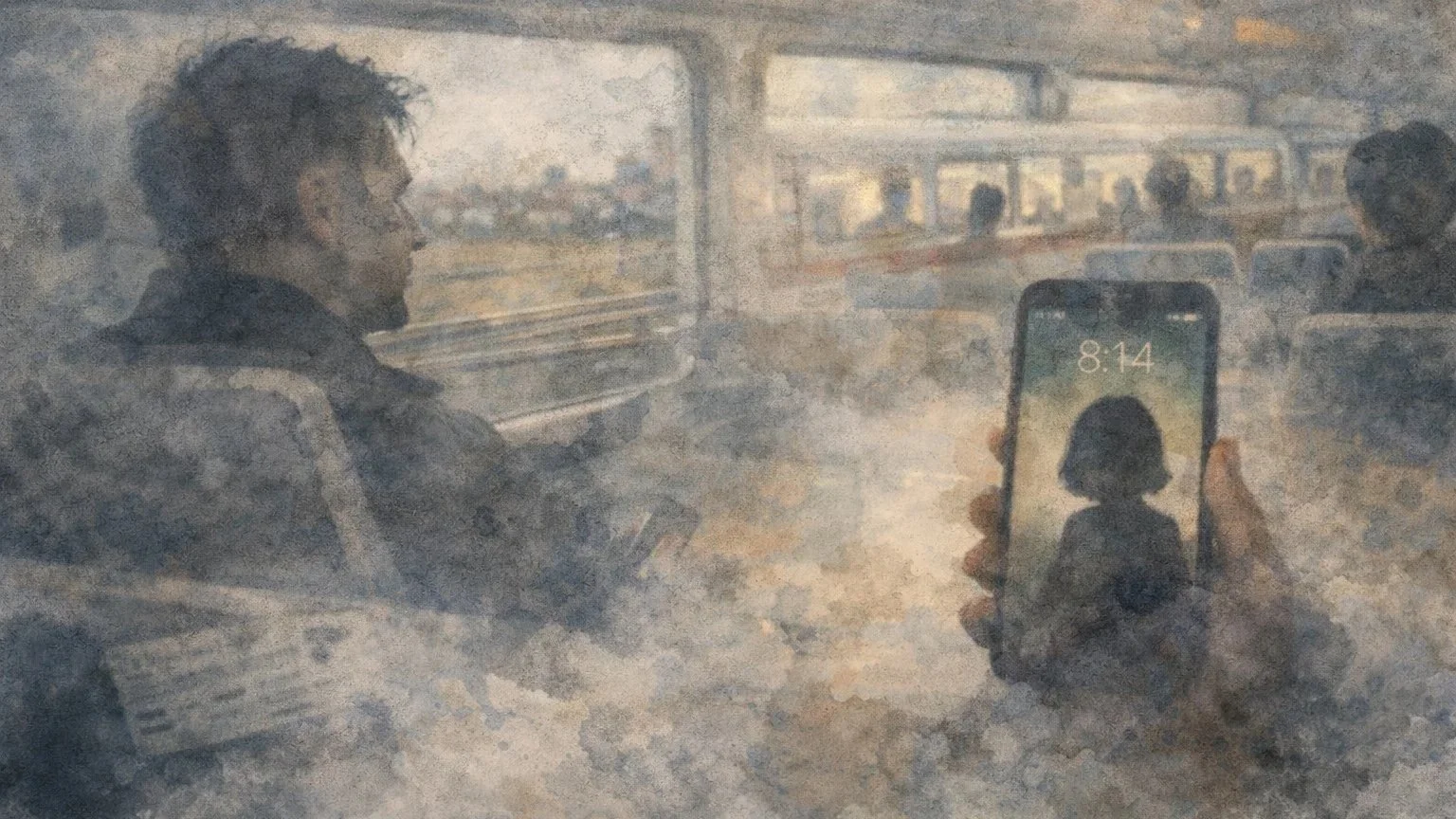
He saw her on a stranger’s phone.
It happened in the ordinary way these things always do. A man in a navy coat lifted his mobile from his pocket as the train lurched, thumbed the side button to check the time, and for half a second the screen lit up.
A child smiled back.
Tom only really registered the hair first. The colour of it. Pale and slightly wild, pinned badly on one side with a yellow clip. Then the slope of the cheeks, the little gap between the front teeth, the knitted red cardigan she insisted on wearing even when it was too warm because she liked the pockets.
His whole body tightened before his mind caught up.
It was Isla.
Or it was so much Isla that the distinction didn’t matter for the first few seconds.
The man locked the phone again and tucked it away. The train rattled on through the back edges of town, past low warehouses, clipped gardens, tired brick terraces, car parks, sidings, patches of scrub. Across the aisle, someone unwrapped a cereal bar. At the far end of the carriage, two schoolboys laughed at something on TikTok. The electronic sign flickered from the name of one small station to another, both places the kind you pass through more often than you choose.
Tom kept staring at the pocket where the phone had gone.
He hadn’t seen Isla in eleven months.
That sentence still did not feel like a sentence that belonged to him. It felt theatrical, or criminal, or like something said by a man in a pub after his fourth pint, staring into the wrong part of the room.
The truth was smaller and meaner than that.
He had seen her, technically. Across roads. On video calls that froze at the wrong moments. Once through the steamed-up window of a soft play centre when Rachel hadn’t known he was there. Once in the crowd outside a primary school Christmas thing where he’d stood too far away to wave and then told himself that was noble somehow.
But he had not seen her seen her. Not held her hand. Not had her talk nonsense at him from the back seat. Not cut her toast into the exact geometry she preferred. Not heard her ask him one question after another until the world felt stitched together by her wanting to know things.
The lawyers had called it an interim arrangement.
Rachel had called it stability.
Tom, on his better days, called it consequences.
On his worst days, he called it theft.
The man in the navy coat took his phone out again. This time Tom was ready. He watched openly, shamelessly, feeling his heartbeat in his throat.
The wallpaper was definitely her.
Or no. Not definitely. But close enough to strip every other thought from his head.
A girl of about five, maybe six, standing in a park in front of a low iron fence, one foot turned inward, smiling as though she’d just been told a secret. The red cardigan. The yellow clip. One hand raised mid-wave.
Isla was six.
Tom leaned forward. He heard himself say, “Sorry.”
The man looked up.
“Sorry,” Tom said again, already aware of how deranged he sounded. “Can I ask - your wallpaper - that little girl - is that your daughter?”
The man’s face changed at once, not into fear exactly, but into the guarded blankness commuters deploy when a stranger begins a sentence with too much intent.
“Yes,” he said.
Tom nodded too quickly. “Right. Sorry. It’s just she looks exactly like-”
He stopped.
Like my daughter, who I no longer have the right to casually mention in public without sounding like a danger to someone.
The man waited.
Tom tried again. “She looks exactly like someone I know.”
The man’s expression softened a fraction, though not much. “Funny.”
“Yeah.”
Silence pressed in around them. The train slowed.
Tom should have left it there. Any sane person would have. But there was something not just familiar about the image. Something wrong in a way familiarity alone could not account for. The red cardigan was one thing. Lots of children owned red cardigans. The yellow clip too. Coincidences happened all the time. The world mass-produced lives. You turned up at a playground and saw six versions of your own child assembled from catalogues of hair and shoes and supermarket coats.
But the pose.
That was what troubled him.
The strange half-wave, half-reach of the hand. Isla did that when she was about to ask to be picked up. Rachel used to say it looked like she was hailing a taxi.
Tom swallowed. “Did you take that photo?”
The man frowned now. “What?”
“The picture.”
“Yes.”
“Recently?”
The man slipped the phone back into his pocket. “Look, mate.”
“No, sorry, I know,” Tom said quickly. “I know how this sounds.”
Apparently he didn’t, because it sounded worse each time he opened his mouth.
The man stood as the train pulled into Paddington. “You take care.”
Then he was gone, carried out with the tide of commuters before Tom had properly moved.
For a second Tom remained seated, stunned by the speed with which normal life had resumed around him. Then he lurched up and followed, too late, out onto the platform.
He saw the navy coat once near the escalators, then lost it in the current of black puffers, wool coats, briefcases, tote bags, umbrellas, takeaway cups.
He stood still and let people buffet past him.
Maybe it wasn’t her.
That was the sensible explanation. The adult explanation. The explanation you landed on if you wanted the day to continue.
But another possibility had already pushed its way in, cold and absurd and impossible to evict.
Maybe it was her.
Not literally. Not in the boring, criminal sense. He didn’t suddenly believe some stranger had acquired his child and put her on his lock screen like a trophy. Even in panic, the mind could reject certain melodramas.
No, it was worse than that. Stranger. Softer. More humiliating.
Maybe that man had a daughter who looked like Isla because in some other version of Tom’s life, that was Isla.
Maybe that was what he had seen: not a coincidence, but a leak. A seam left open. One life pressing briefly against another on the busy service at 8:14 in the morning.
In that other life, perhaps the court hearing had gone differently.
Perhaps he had not sent the message he sent at 1:07 a.m., the one Rachel screenshot and handed over with tears in her eyes and which even Tom, rereading it later, could not fully defend. Perhaps he had gone home instead of staying out. Perhaps he had got help sooner. Perhaps he had become the kind of man other men did not flinch from on trains.
Or perhaps this had nothing to do with Rachel at all. Perhaps this was older than that.
Perhaps there was a life in which he never met Rachel, but met someone else, and they had a daughter who was not Isla but looked enough like her to haunt him.
Perhaps there was a life in which he still lived in the house with the green front door and the cracked bathroom tile and the pencilled marks in the kitchen showing Isla’s height at three, four, and “four and a quarter.”
Perhaps there was a life in which he was the man in the navy coat.
He went to work but did no work. At eleven he was still staring at the spreadsheet open on his monitor, the cells blurring into a hospital-green grid. At one he ate a sandwich without tasting it. At three he searched social media for combinations of Rachel’s surname, the park in the photo, yellow hair clips, school uniforms, mutual friends, anything. At five he told his manager he had a migraine and left.
That night, in his flat, he opened the old backups.
He told himself he was looking for proof that the wallpaper could have been copied from somewhere. A shared image. A forgotten upload. Something explainable.
But what he was really doing was archaeology.
The backups lived on two hard drives in a drawer beneath a stack of unpaid parking notices and dead cables. Years of exported phones, half-organised folders, digital sediment. He plugged one in. Family holidays. The allotment. Rachel asleep on the sofa under a blanket patterned with foxes. Isla in the bath with a beard of foam. Isla holding a plum like Hamlet with Yorick’s skull. Isla in that red cardigan on a swing, on a wall, on a train, in the garden, on the kitchen floor.
He found the cardigan photos quickly.
He found the yellow clip.
He found the park.
Not the same park. Almost the same, but not the same. Same kind of railings. Same municipal bench. Same rubberised play surface. Same anonymous bit of South Dale pretending not to be tired.
Then, forty-seven minutes in, he found the pose.
Isla standing in weak spring light, one foot turned inward, hand lifted in that odd little hail. Mouth just parting into a smile. Wearing the red cardigan and the yellow clip.
Tom stared until his eyes watered.
It was not the same photo.
But it was almost the same moment.
His skin prickled. The difference was tiny and total. In his picture, Isla was looking past the camera, toward Rachel. In the one on the train - unless his panic had embroidered it - she was looking directly into the lens.
He enlarged the image until it pixelated. He studied the fence, the sleeve, the angle of the head. He felt ridiculous and terrified and more awake than he had in months.
At some point the flat grew dark around him.
He didn’t switch the lights on.
He sat with the glow of the screen and thought about all the lives a person fails to live. Not in the grand cinematic sense. No violins. No alternate empires of the self. Just the small branchings. The petty divinations.
What if he’d left five minutes earlier that morning?
What if he’d sat in a different carriage?
What if he’d never looked up?
How many parallel worlds did it take before one delivered a glimpse across?
And why that glimpse? Why not something useful? Why not numbers for the lottery, or the cure for regret, or a straightforward sign saying This is where you went wrong, Tom, and here is how to walk back to the junction?
Instead he got a wallpaper. A maybe. A child’s face translated through glass and motion and somebody else’s life.
He slept badly. Dreamed of trains running side by side in darkness, lit windows flashing faces at him too quickly to recognise.
In the morning he took the same service on purpose.
He stood instead of sitting. Watched every passenger who checked the time. Every lit screen. Every lock screen couple, dog, mountain, football team, ultrasound, holiday sunset, sullen teenager, bouquet, beach, meme, baby.
Nothing.
He did it again the next day. And the next.
By Friday he knew it had become a ritual, then a superstition, then something close to faith.
He wasn’t looking for the man anymore, not exactly. He was looking for permission to believe that lives could brush against each other. That you were not, in fact, trapped forever in the one you’d mismanaged. That somewhere, not even in heaven, just one track over, another version of you had not fumbled the thing you loved most.
On Monday, he saw the phone again.
Not the man. A woman this time, standing by the doors, holding onto the pole with one hand and a mobile in the other. Her wallpaper flickered when a notification came in.
It was not Isla.
It was Tom.
Or someone impossibly like him.
A man in profile, older by perhaps five or six years, more lined but somehow lighter, holding the hand of a girl just out of frame. They were crossing a beach under a blown-white sky. The man was smiling at something the child had said.
Tom stared so hard that the woman noticed and turned the phone away slightly, protective, irritated.
He looked down at the floor, nauseous.
By the time he got off his hands were shaking.
That evening he did not open the backups. He did not search anything. He did not drink, which lately had become notable enough to count as an action. He sat at the kitchen table with a pad of paper and wrote down everything he could still change.
It was not a long list.
Call solicitor.
Email apology.
Attend meeting Wednesday.
Delete drafts not meant to be sent.
Ask about supervised visits without making it about rights.
No self-pity in writing.
No blame.
No “you made me.”
No “if only.”
When he stopped, he looked at the list for a long time.
It was possible, he realised, that he had mistaken the whole thing.
Possible there were no sliding doors, no parallel bleed-through, no railway-haunting proof that other versions of himself persisted somewhere beyond sight. Possible that grief and routine and the particular fluorescent sadness of commuter rail had simply made him susceptible to patterns.
Possible he had frightened an innocent man, then built a theology out of a coincidence.
But even if that was true, the effect remained.
He had seen his daughter in a stranger’s life.
Then he had seen himself in one.
And now, for the first time in nearly a year, Tom understood that confusion was not always a void. Sometimes it was a corridor. Sometimes it was the brief, unbearable privilege of recognising that the life you had may not be the only life that was ever available to you.
The next morning, just before leaving for the station, his phone buzzed.
An email reply.
Not warm. Not forgiving. Not even encouraging, really.
But not nothing.
Rachel had written:
You can ask through the proper channels.
Then, below it, after a gap big enough to imply reluctance:
She still wears that silly red cardigan, by the way. Won’t let me throw it out.
Tom sat on the edge of the bed and read it three times.
Outside, a train went past somewhere beyond the houses, metal singing against metal.
For the first time in months, he did not imagine it carrying him away from his life.
Only toward one.